
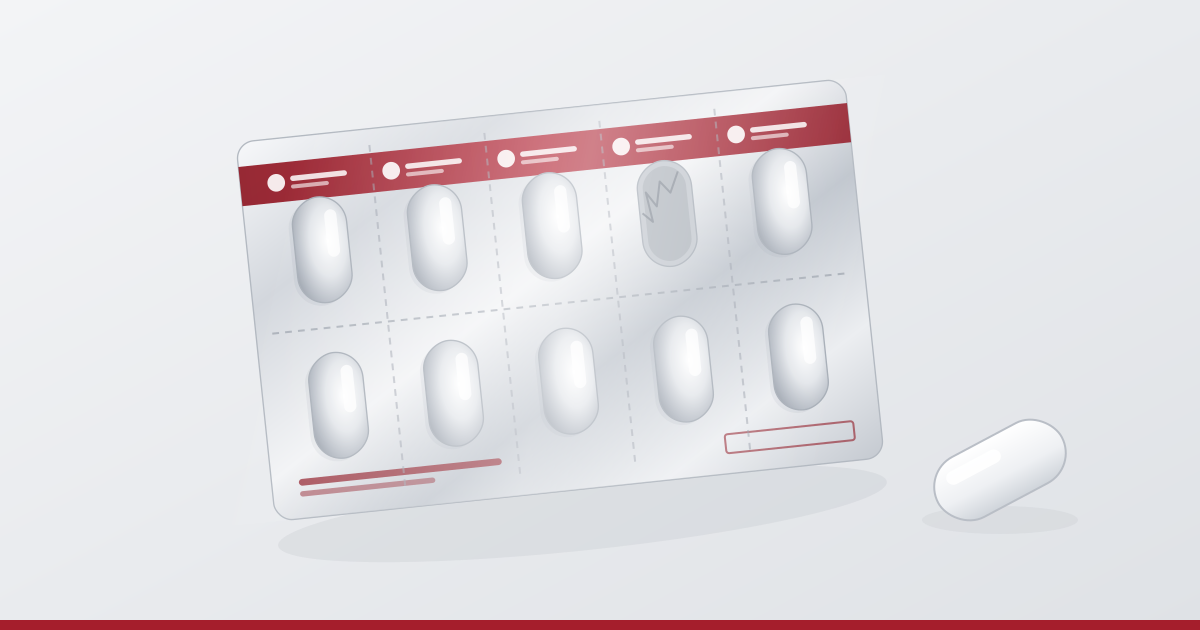
A blister pack holds products such as tablets and capsules in individual cavities. The cavities are closed with a lidding foil that is sealed onto the base. In this article we briefly explain what lidding foil is, what it does and what to look out for when choosing it.
How a blister is built
- Base with cavities: The layer that holds the product. Depending on the need, it can be a plastic film or an aluminium-based laminate.
- Lidding foil: The foil that closes the cavities. A heat-seal coating on its inner side bonds it to the base under heat and pressure.
What the lidding foil does
Protects
Aluminium foil is a good barrier against moisture, light and air. Because each cavity is sealed separately, opening one does not affect the others.
Opens
The product is usually pushed through the foil by pressing on the cavity; in some packs the foil is peeled off instead.
Informs
The product name and usage information can be printed on the foil. Variable data such as batch numbers is often added during packing.
If the information needs to be on the foil, printed foil is the choice; if it is on the outer packaging, plain foil is enough. All the foil we produce at Teknas is aluminium foil.
What to consider when choosing
- The lidding foil must be compatible with the base it will be sealed to.
- How sensitive the product is to moisture, light and air affects the foil structure.
- The foil size and format must suit your packaging machine.
- The regulations that apply to your product and your company's quality requirements are decisive; share them at the quote stage.
Designing a printed lidding foil
- Text must be large enough and have enough contrast to be read on the shiny foil surface.
- How the text and logo sit in relation to the cavities is planned together with the foil size.
- If the blister can be split, users appreciate having the key information readable on every piece.
- Space can be left in the design for information added during packing.
What we need for a quote
- Your product and the external factors it is sensitive to
- The base material and the packaging machine you use
- The foil size, if you know it
- Approximate order quantity and whether you need printing
Blisters are closely associated with medicines, but they are also used for supplements, cosmetics and veterinary products. Whatever your industry, the foil is chosen to suit the product's structure and how it is used.